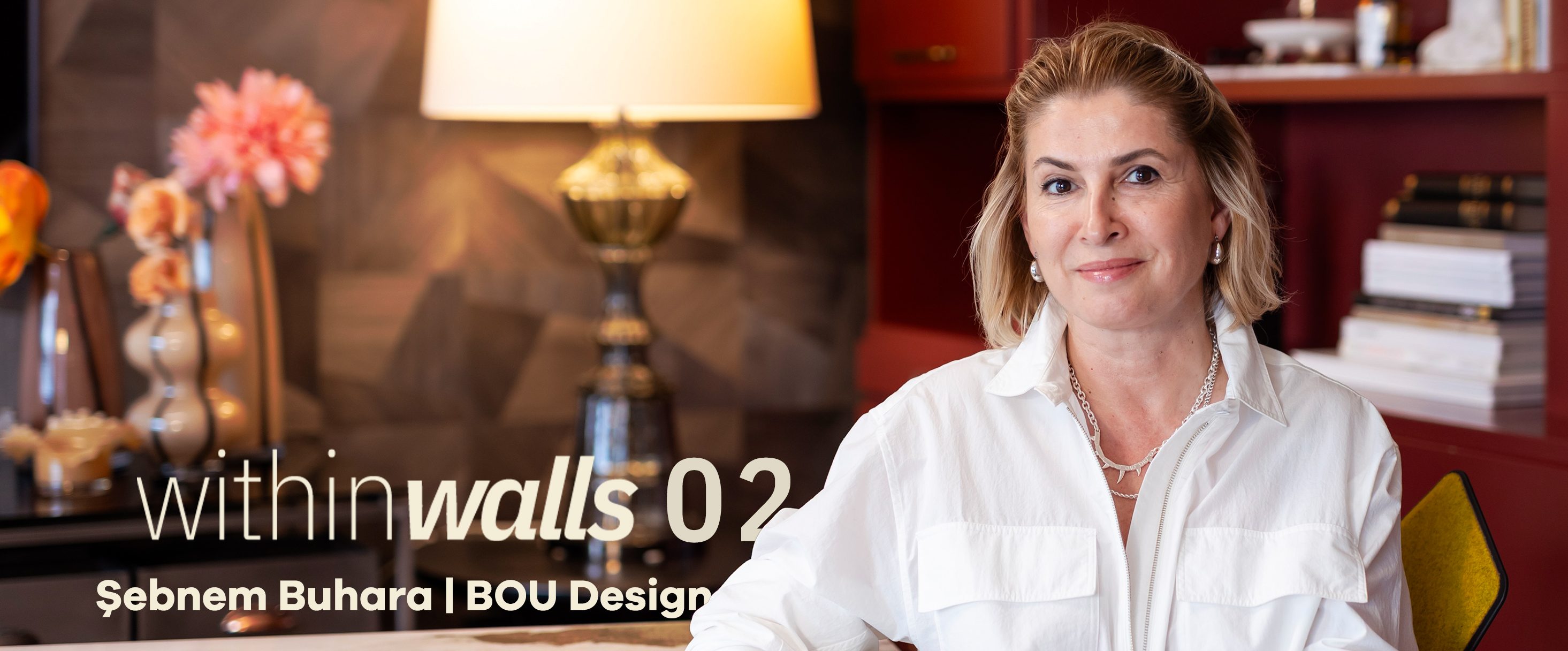
Şebnem Buhara is a person in motion — even when she is standing still. Founder of BOU Design Studio and one of Turkey’s most recognized interior architects, she has spent the better part of three decades pushing herself and her work toward something more. This year, she chose a different direction: inward. Inside her Istanbul studio, surrounded by art, glass, and the particular light of a city she has always watched carefully, she reflects on limits, materials, meaning, and what it means to finally steep.
If Şebnem Buhara were a material, she would be ceramic. Not for its beauty or its permanence, but for its paradox: shaped by pressure, transformed by heat, capable of extraordinary things — but only up to a point. Push too far, and it breaks. “When done right,” she says, “it can yield truly great works.” She believes the same is true of people.
This kind of self-awareness — precise, unsparing, and quietly generous — runs through everything Buhara says. After 26 years in architecture and interior design, she has arrived at a relationship with her own practice that resembles something between mastery and surrender. She knows what she is. She knows what she can do. And she has recently learned to let that be enough.
Her path into architecture was not planned. She studied electronics in high school. The decision to become an architect arrived during her university entrance exam — without warning, without explanation. What emerged from that unlikely beginning is a practice defined by timelessness. Buhara does not design for trends. When she visits a home she designed fifteen years ago, it still looks as if it were made last year.

A space has no energy on its own. That energy comes alive through the people who inhabit it.
SEBNEM BUHARA
For Buhara, the soul of a space is not something a designer creates. It is something they release. A space, she argues, has no energy of its own — it exists only in relation to the people who inhabit it. The art on the walls, the objects on the shelves, the particular quality of light at a specific hour: these are the elements that make a space alive.
This is why lighting, for her, is not a technical matter but a philosophical one. “Nothing looks as rich as a properly lit space,” she says. “Nothing else reveals the eye like that.” It is the first thing every architect must truly learn — and the most important thing that defines a space.
She came to sculpture by accident. A wrist injury during her university years led to surgery and then to a strange kind of creative redirection. Unable to express herself through drawing, she began expressing through making. Later, while collaborating with sculptor Ozan Ünal on the Tree of Life installation at Zorlu, she found herself in a studio, making sculpture. “I fell in love with the earth,” she says.
This year brought a new kind of question. Her son turned eighteen and left for university. The goals she had set — and met — left a sudden void. Instead of setting new targets, she chose to slow down. To savor what she had built. To steep. “I turned steeping into a goal in itself,” she says. It is not complacency. It is something harder to achieve — the decision, made deliberately, to be exactly where you are.